The demand for ultrapure water in industrial processes has grown significantly, driven by the critical need for sustainable operations and regulatory compliance.
Liquid fertilizer production is among the industries requiring ultrapure water to enhance agricultural productivity and ensure the efficiency of chemical reactions while maintaining stringent product quality standards.
Challenges:
A leading fertilizer manufacturer in India was looking for a sustainable high-purity water generation system that could produce 6.70 m³/hr of ultrapure water with a conductivity below 0.5 µS/cm. Traditional cation-anion mixed bed systems were inadequate, as they could not meet the manufacturer’s goals for sustainability and operational efficiency.
The Manufacturer required a consistent ultrapure water quality with 24/7 operation, free from fluctuations and required zero wastewater from regeneration to eliminate the need for effluent treatment. To meet their sustainability and operational expectations, the manufacturer required minimal piping, and a fully automated system with no manual intervention required.
QUA’s Solution:
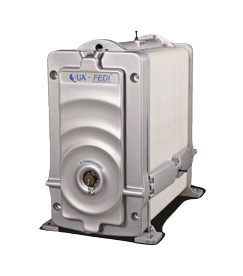
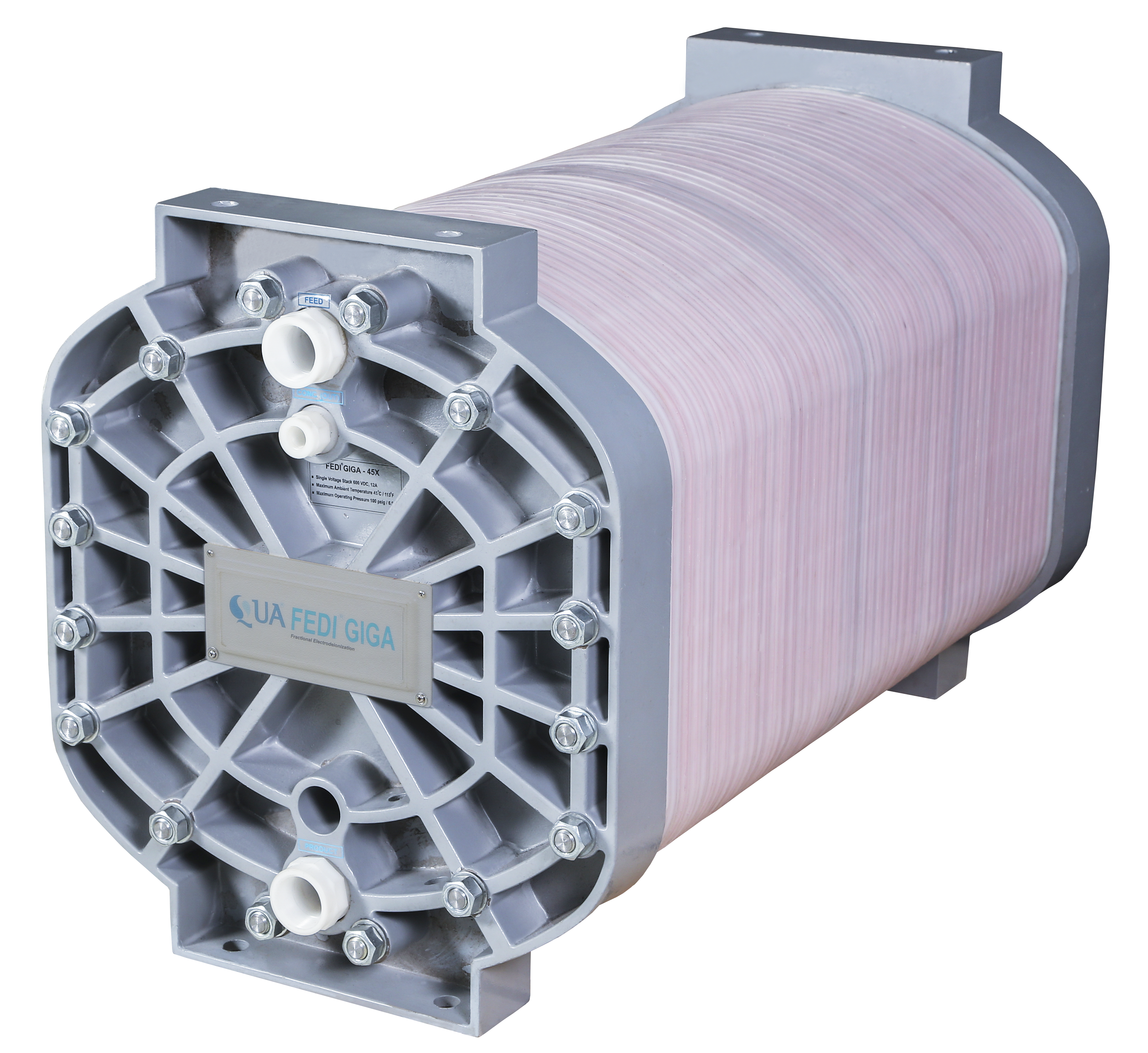
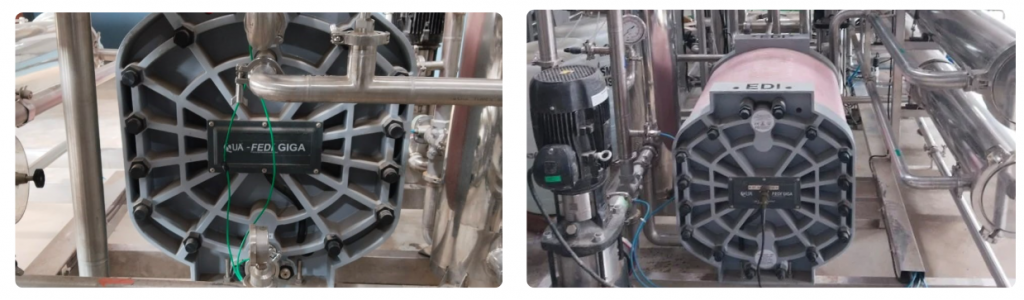
QUA’s FEDI® GIGA technology was deployed to address the manufacturer’s challenges related to complex water treatment systems. The FEDI® Giga is a cutting-edge electrodeionization (EDI) technology designed to produce ultrapure water with a high flow capacity.
As the first electro-deionization stack with three ports—feed, product, and reject—the FEDI® GIGA simplifies integration, significantly streamlining installation and reducing overall system complexity.
The system integrates multiple advanced water treatment technologies, including multigrade and activated carbon filters, two-pass reverse osmosis (RO) for advanced desalination and impurity removal, and the FEDI® GIGA for the final polishing step. The FEDI® GIGA can be seamlessly integrated into an RO skid, maximizing space efficiency and reducing the overall system footprint.
Flow Diagram:

Results:
The implementation of QUA’s FEDI® Giga Technology enabled the fertilizer manufacturer to consistently produce 6.70 m³/hr of ultrapure water with conductivity below 0.5 µS/cm, complying with the manufacture’s strict quality standards, and enhancing overall operational efficiency.
This case demonstrates QUA’s ability to address the stringent water quality requirements of industries such as fertilizer manufacturing. The FEDI® Giga system not only met the ultrapure water demands but also aligned with the customer’s sustainability objectives. With QUA’s advanced technologies, industries can achieve operational excellence and regulatory compliance, setting benchmarks for sustainable industrial practices.