
The client is the largest cement company in India and amongst the leading producers of cement globally, providing a range of products that cater to the various aspects of construction, from foundation to finish. The company is also India’s largest exporter of cement.
The client’s captive power plant had a conventional ion exchange based demineralization system, which was used to produce demineralized water for their high pressure boiler application. Due to the scarcity of fresh water available in the region, the client decided to recycle the wastewater generated in the facility and reuse it for boiler makeup. This solution would also enable them to reduce their fresh water intake.
Combined influent from three wastewater sources were considered for recycle – boiler blow down, cooling tower make-up waste, and coal washer. All three of these streams were previously being discharged as wastewater.
The end user and the consultant evaluated various demineralization technologies to recycle and reuse the power plant waste. The available technologies are conventional pretreatment followed by ion-exchange based demineralization, reverse osmosis (RO) followed by mixed bed/electrodeionization and thermal evaporation.
Treating the wastewater through conventional pretreatment and demineralization has various operational and performance issues like resin fouling, frequent chemical cleaning resulting in additional downtime and waste generation.
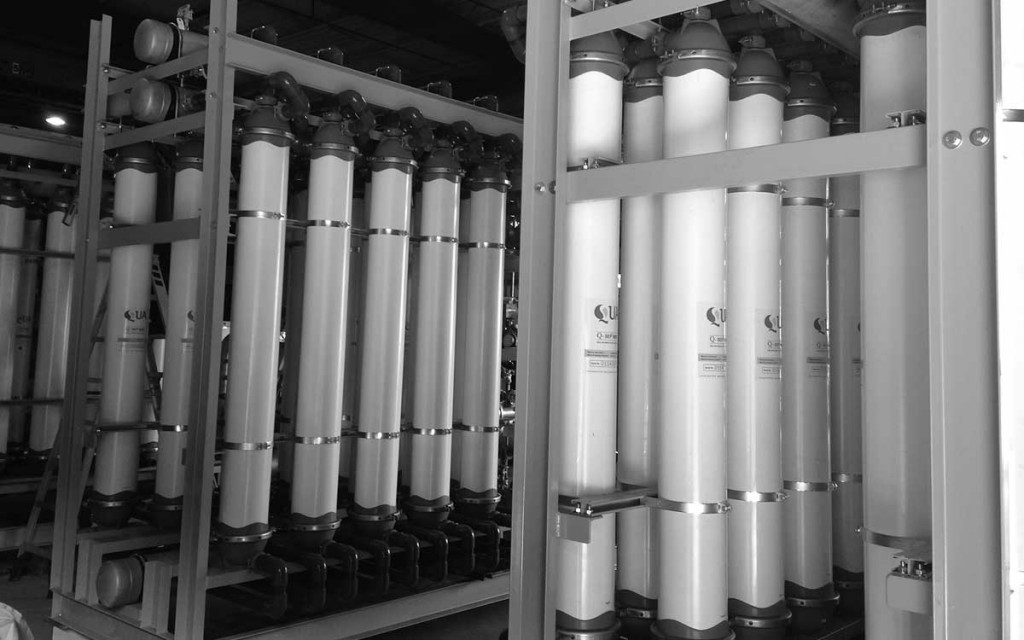
The end user and consultant finally decided to go for a membrane-based scheme comprising of ultrafiltration and reverse osmosis process followed by fractional electrodeionization (FEDI) as they found it to be the most viable option in terms of higher reliability, lower capital expenditures and lower operational expenditure in comparison to other technologies.
RO has become most popular process for recycling and reuse of different types of wastewater. It typically removes 95-99% of dissolved impurities from the feed water. At the same time it is prone to scaling and fouling due to presence of certain feed contaminants. Fouling in RO membranes is due to presence of colloidal/suspended impurities, bacteria/viruses and oil and grease. The fouling of RO membranes due to colloids/suspended particles and oil and grease is generally irreversible and hence robust pretreatment of the wastewater is required to remove these contaminants before it is fed to the RO unit. In this regard, maintaining the silt density index (SDI) value of less than 3 is a prerequisite to RO to prevent such fouling.
Conventional filtration methods using clarifiers and media filters do not ensure a consistent SDI value below 3. Ultrafiltration membranes have a pore size is less than 0.1 microns, which results in excellent rejection of colloidal particles, bacteria and viruses from the feed water. Ultrafiltration in the pretreatment to RO provides a reliable solution for achieving consistent SDI value below 3 thus safeguarding the RO units from particulate/colloidal fouling.